Sarnath Guide 2026: Dhamek Stupa, Ashoka Pillar, Museum and Sarnath Timings
Most people who come to Varanasi end up in Sarnath for a morning, and most of them tell us afterwards they wish they'd known a little more before they went. So here's what we'd tell you if you were sitting in the back of one of our cabs on the 12 km run out of the city (it takes 30 to 45 minutes, depending on how bad the Pandeypur crossing is that day).
Why Sarnath matters, in one breath: a few weeks after he found enlightenment at Bodh Gaya, the Buddha walked all the way here and gave his very first sermon to five men who'd once practised with him, in a deer park that was then called Isipatana. That's it. Nearly everything you'll see in Sarnath is tied, one way or another, to that single morning, which is why pilgrims from Sri Lanka to Japan treat it as one of the four holiest places in Buddhism.
The good news is that it's small. You don't need a whole day. Do it in the order below and you'll be back in Varanasi for lunch.
Places to see in Sarnath (in the order we'd do them)
Chaukhandi Stupa, on the way in
You'll pass this brick mound on your left before you reach the main complex, and it's worth the stop. Tradition says this is where the Buddha ran into his old companions on his way to Sarnath. The odd octagonal tower sitting on top has nothing to do with Buddhism at all, funnily enough: Akbar put it up in 1588 to mark a visit his father Humayun had made. Fifteen minutes is plenty. Handy to know, too, that it's open on Fridays, which the museum isn't.
Dhamek Stupa and the excavated site
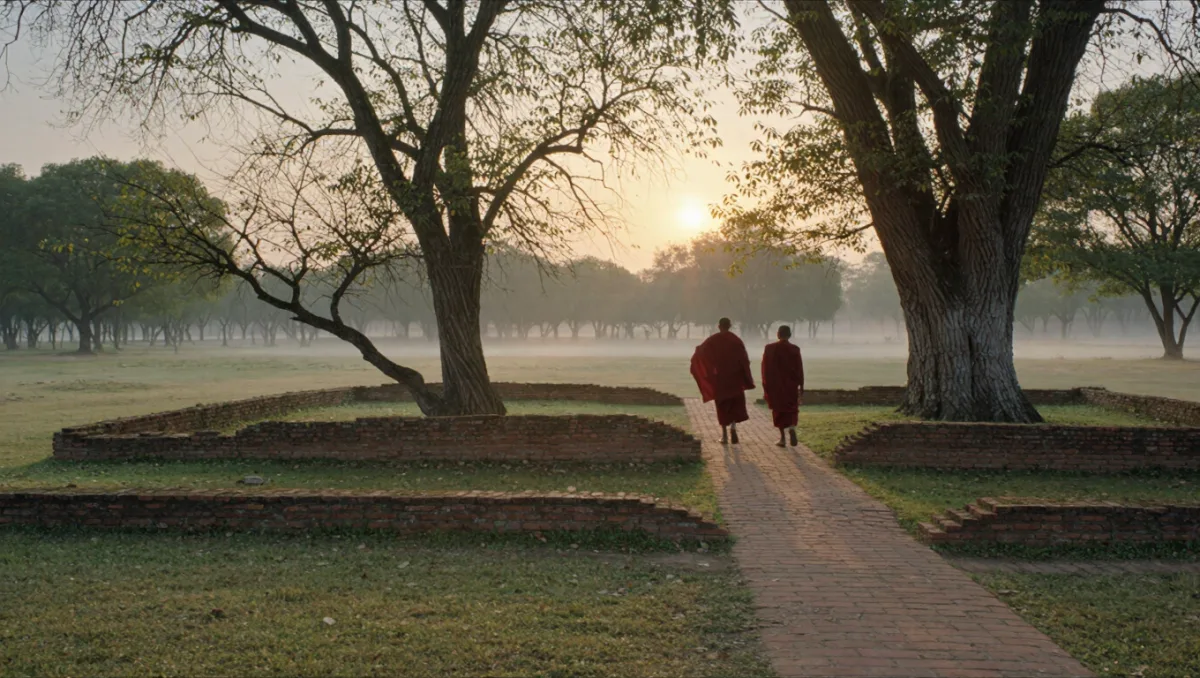
This is the heart of the place. You walk through an ASI-run park full of low red-brick walls (the foundations of monasteries that stood here for well over a thousand years) and at the far end there's the Dhamek Stupa, a huge solid drum of stone and brick roughly 43 metres high and 28 across. What you're looking at is mostly Gupta work from around 500 CE, built over older stupas, and it's believed to stand on the spot where that first sermon was given.
Do walk all the way round it. The lower band of stone is covered in fine carving, flowers and swirling geometric patterns, and most visitors walk right past it looking up. You'll also see monks from Thailand, Tibet, Myanmar and Sri Lanka circling it and chanting pretty much all day, so remember it's a living place of worship rather than a ruin; keep your voice down and go round clockwise.
The Ashoka pillar
Inside the same enclosure, under a little shelter, you'll find the broken stump of the Ashoka pillar that the emperor raised here in the 3rd century BCE. The inscription on it (still readable, if you know Brahmi) is a stern warning to monks and nuns not to split the Sangha. What you won't find on it are the famous lions, and that's where people get confused, because they're across the road in the museum.
The Sarnath museum and the Lion Capital
Set up in 1904, it's the oldest site museum the Archaeological Survey of India has, and honestly it's the reason a lot of people make the trip. The star is the Lion Capital of Ashoka, four lions sitting back to back over a wheel, which India took as its national emblem in 1950 (the wheel on the flag comes from the same stone). Hang around the seated Buddha from the 5th century too, the one with his hands in the teaching gesture; it's about as fine as Gupta sculpture gets.
- It's shut on Fridays. We can't stress this enough, it's the mistake that catches out more people than anything else.
- Hours are roughly 10 AM to 5 PM.
- You can't take photos inside, and bags have to go in the cloakroom.
Mulagandha Kuti Vihar (the "Sarnath temple")
If someone's told you to see "the Sarnath temple", this is almost certainly the one they meant. It's modern, opened by the Maha Bodhi Society in 1931, and the walls inside are covered in murals of the Buddha's life by a Japanese painter, Kosetsu Nosu, which are lovely in a quiet, unshowy way. Out in the garden there's a Bodhi tree grown from a cutting of the sacred tree in Anuradhapura, Sri Lanka, which itself came from the one in Bodh Gaya, so it's a sort of grandchild of the tree the Buddha sat under. If you can hang on for the evening chanting, do.
The deer park and the monasteries
Just behind the temple is a small deer park, a nod to the Isipatana of the story. Then along the main road you've got temples put up by different Buddhist countries, each in its own style (Thai, Japanese, Tibetan, Burmese and more), and every one of them is free to walk into. You'll spot the 80-foot standing Buddha at the Thai temple from the road long before you get there.
Sarnath timings and tickets
The Dhamek Stupa site is open from sunrise to sunset. The ASI ticket works out at about ₹25 if you're Indian (or from a SAARC or BIMSTEC country) and ₹300 for other foreign visitors, and there's a QR code at the gate you can scan to skip the ticket queue. The museum, as we said, runs roughly 10 to 5 and closes on Fridays, with its own small ticket. Chaukhandi has an ASI ticket as well. The temple, the monasteries and the deer park don't charge anything. One caveat: the ASI changes its fees now and then, so check at the counter rather than holding us to the rupee.
A half-day Sarnath plan that works
Leave Varanasi at about 8 in the morning. It's cooler, the site is quieter, and the low light on the stupa is at its best. You'll be at Chaukhandi by 8:45, spend a quarter of an hour there, then give the stupa, the excavated site and the pillar a good hour from about 9:15. The museum takes 45 minutes after that (skip it on a Friday, obviously), then half an hour at Mulagandha Kuti Vihar and the deer park, and a wander past the Thai temple and a monastery or two. Head back around 11:30 and you're in the city by one.
Only got a single day in Varanasi? Flip it round: Sarnath first thing, Kashi Vishwanath and the old lanes after lunch, then the Ganga Aarti from a boat as it gets dark. That's exactly how our Varanasi local sightseeing day is put together.
Getting to Sarnath from Varanasi
Take a cab. An auto will get you there cheaply enough, but finding one back is a bit of a lottery. With us it's a fixed round-trip fare with the driver waiting up to four hours: ₹1,200 in a Swift Dzire for up to four people, ₹1,800 in an Innova Crysta for six, ₹2,400 in a 12-seater tempo traveller and ₹3,000 in a 17-seater. The full breakdown is on the Varanasi to Sarnath page. And if Sarnath has you hooked on the Buddhist circuit (Bodh Gaya, Rajgir, Kushinagar, even Lumbini across the Nepal border), have a look at the Varanasi to Bodh Gaya route next.
Frequently asked questions
1. How far is Sarnath from Varanasi?
It's about 12 km from the middle of the city and roughly 25 km from the airport, so allow 30 to 45 minutes in the car, a bit more if you hit school traffic.
2. Is the Sarnath museum open on Friday?
No, it's closed every Friday. The good news is that the stupa site, Chaukhandi and all the temples stay open, so a Friday visit isn't wasted, you just miss the Lion Capital.
3. How much time do I need in Sarnath?
Three to four hours covers everything worth seeing without rushing. Pilgrims and photographers often end up staying the whole day, though, and nobody minds if you do.
4. Where is the original Ashoka Lion Capital?
It's in the Sarnath Archaeological Museum, right across the road from the excavated site, while the broken pillar it used to sit on is still standing inside the site itself.
5. When's the best time to visit Sarnath?
Anywhere from October to March, and go early in the day. Buddha Purnima (the full moon in April or May) is special, with processions and pilgrims from all over Asia, but expect it to be packed.
6. Is there a dress code?
Nothing formal, but it's a holy site for a lot of people, so cover your shoulders and knees and slip your shoes off wherever the temples ask you to.
Heading to Sarnath? We'll send a driver who waits while you take your time. Call or WhatsApp us on +91 92503 31290, or plan your trip online and we'll get back to you.
Book Your Varanasi Trip Today
Need a tempo traveller, cab, or luxury bus for your Varanasi pilgrimage? Varanasi On Wheels offers 24/7 service with transparent pricing.